How Sustainable Supply Chain Operation Management Enhances Enterprise Perceived Low-Carbon Development Efficiency: Evidence from Manufacturing Enterprises
Authors
Files
Key Information
Journal
Published in Vol. 1 No. 3 (2026) of Sustainable Management Review.
Sustainable Management Review (SMR) is a multidisciplinary, peer-reviewed international journal dedicated to advancing research on sustainable management and sustainable development across disciplines. SMR welcomes sustainability-oriented studies from diverse academic fields, including but not limited to economics and management, public administration, culture, education, sociology, communication, law, environmental studies, biology, chemistry, materials science, engineering, water resources management, and other STEM-related areas. The journal encourages scholars to examine the application, transformation, and development of sustainability principles from organizational, social, technological, ecological, and institutional perspectives, thereby providing theoretical support and practical insights for more responsible, resilient, and future-oriented models of management and development.
ISSN3106-5805 eISSN3106-5813
About the JournalAbstract
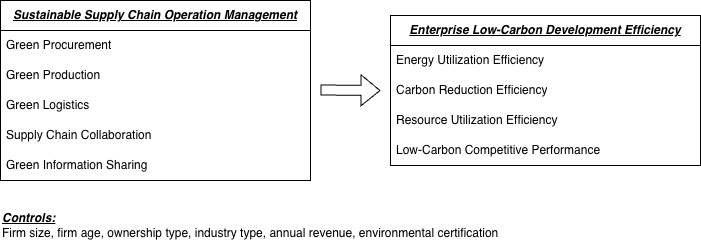
This study examines how sustainable supply chain operation management enhances enterprise perceived low-carbon development efficiency in manufacturing enterprises. A quantitative survey design was adopted. Data were collected from 384 respondents, including supply chain managers, production managers, operations managers, logistics managers, ESG or environmental officers, and senior administrative staff. Structural equation modelling was used to test the effects of five supply chain operation practices on four low-carbon development outcomes. The results show that green procurement, green production, green logistics, supply chain collaboration, and green information sharing positively predict enterprise perceived low-carbon development efficiency. Green production shows the strongest effect on carbon reduction efficiency, while supply chain collaboration and green information sharing are particularly important for low-carbon competitive performance. This study extends sustainable supply chain management research by examining multiple operational dimensions and multiple low-carbon efficiency outcomes simultaneously.
References
Anderson, J. C., & Gerbing, D. W. (1988). Structural equation modeling in practice: A review and recommended two-step approach. Psychological Bulletin, 103(3), 411–423. https://doi.org/10.1037/0033-2909.103.3.411 DOI: https://doi.org/10.1037/0033-2909.103.3.411
Churchill, G. A., Jr. (1979). A paradigm for developing better measures of marketing constructs. Journal of Marketing Research, 16(1), 64–73. https://doi.org/10.1177/002224377901600110 DOI: https://doi.org/10.1177/002224377901600110
Fornell, C., & Larcker, D. F. (1981). Evaluating structural equation models with unobservable variables and measurement error. Journal of Marketing Research, 18(1), 39–50. https://doi.org/10.1177/002224378101800104 DOI: https://doi.org/10.1177/002224378101800104
Gao, D., Mo, X., Xiong, R., & Huang, Z. (2022). Tax Policy and Total Factor Carbon Emission Efficiency: Evidence from China's VAT Reform. International journal of environmental research and public health, 19(15), 9257. https://doi.org/10.3390/ijerph19159257 DOI: https://doi.org/10.3390/ijerph19159257
Golicic, S. L., & Smith, C. D. (2013). A meta-analysis of environmentally sustainable supply chain management practices and firm performance. Journal of Supply Chain Management, 49(2), 78–95. https://doi.org/10.1111/jscm.12006 DOI: https://doi.org/10.1111/jscm.12006
Green, K. W., Zelbst, P. J., Meacham, J., & Bhadauria, V. S. (2012). Green supply chain management practices: Impact on performance. Supply Chain Management: An International Journal, 17(3), 290–305. https://doi.org/10.1108/13598541211227126 DOI: https://doi.org/10.1108/13598541211227126
Gupta, P., Sharma, Y., Chauhan, A., Parewa, B., Rai, P., & Naik, N. (2025). Investigation of green supply chain management practices and sustainability in Indian manufacturing enterprises using a structural equation modelling approach. Scientific reports, 15(1), 14909. https://doi.org/10.1038/s41598-025-95940-9 DOI: https://doi.org/10.1038/s41598-025-95940-9
Hu, L. T., & Bentler, P. M. (1999). Cutoff criteria for fit indexes in covariance structure analysis: Conventional criteria versus new alternatives. Structural Equation Modeling: A Multidisciplinary Journal, 6(1), 1–55. https://doi.org/10.1080/10705519909540118 DOI: https://doi.org/10.1080/10705519909540118
Karaman, A. S., Kilic, M., & Uyar, A. (2020). Green logistics performance and sustainability reporting practices of the logistics sector: The moderating effect of corporate governance. Journal of Cleaner Production, 258, Article 120718. https://doi.org/10.1016/j.jclepro.2020.120718 DOI: https://doi.org/10.1016/j.jclepro.2020.120718
Liu, Z., Huang, N., Hu, B., Sun, W., Shi, L., Zhao, Y., & Han, C. (2024). Cross-border supply chain coordination of low-carbon agricultural products under the risk of supply uncertainty. PloS one, 19(10), e0309763. https://doi.org/10.1371/journal.pone.0309763 DOI: https://doi.org/10.1371/journal.pone.0309763
Lu, Y., & Liao, Z. (2025). The influence of AI application on carbon emission intensity of industrial enterprises in China. Scientific reports, 15(1), 12585. https://doi.org/10.1038/s41598-025-97110-3 DOI: https://doi.org/10.1038/s41598-025-97110-3
Meacham, J., Toms, L., Green, K. W., Jr., & Bhadauria, V. S. (2013). Impact of information sharing and green information systems. Management Research Review, 36(5), 478–494. https://doi.org/10.1108/01409171311327244 DOI: https://doi.org/10.1108/01409171311327244
Podsakoff, P. M., MacKenzie, S. B., Lee, J.-Y., & Podsakoff, N. P. (2003). Common method biases in behavioral research: A critical review of the literature and recommended remedies. Journal of Applied Psychology, 88(5), 879–903. https://doi.org/10.1037/0021-9010.88.5.879 DOI: https://doi.org/10.1037/0021-9010.88.5.879
Qu, G., Zhang, Y., Tan, K., Han, J., & Qu, W. (2022). Exploring Knowledge Domain and Emerging Trends in Climate Change and Environmental Audit: A Scientometric Review. International journal of environmental research and public health, 19(7), 4142. https://doi.org/10.3390/ijerph19074142 DOI: https://doi.org/10.3390/ijerph19074142
Seuring, S., & Müller, M. (2008). From a literature review to a conceptual framework for sustainable supply chain management. Journal of Cleaner Production, 16(15), 1699–1710. https://doi.org/10.1016/j.jclepro.2008.04.020 DOI: https://doi.org/10.1016/j.jclepro.2008.04.020
Sánchez-García, E., Martínez-Falcó, J., Marco-Lajara, B., & Sloniec, J. (2025). Unveiling key drivers of green operational efficiency. Journal of the science of food and agriculture, 105(14), 8233–8244. https://doi.org/10.1002/jsfa.70068 DOI: https://doi.org/10.1002/jsfa.70068
Vachon, S., & Klassen, R. D. (2008). Environmental management and manufacturing performance: The role of collaboration in the supply chain. International Journal of Production Economics, 111(2), 299–315. https://doi.org/10.1016/j.ijpe.2006.11.030 DOI: https://doi.org/10.1016/j.ijpe.2006.11.030
Wang, J., Zhu, L., Feng, L., & Feng, J. (2023). A meta-analysis of sustainable supply chain management and firm performance: Some new findings on sustainable supply chain management. Sustainable Production and Consumption, 38, 312–330. https://doi.org/10.1016/j.spc.2023.04.015 DOI: https://doi.org/10.1016/j.spc.2023.04.015
Zhu, Q., & Sarkis, J. (2004). Relationships between operational practices and performance among early adopters of green supply chain management practices in Chinese manufacturing enterprises. Journal of Operations Management, 22(3), 265–289. https://doi.org/10.1016/j.jom.2004.01.005 DOI: https://doi.org/10.1016/j.jom.2004.01.005
Details
License
Copyright (c) 2026 Dong Guo, Wei Yet Tan

This work is licensed under a Creative Commons Attribution 4.0 International License.