Green Finance Management and Corporate Sustainable Innovation: Evidence from a Dual-Path Mechanism
Authors
Files
Key Information
Journal
Published in Vol. 1 No. 1 (2026) of Sustainable Management Review.
Sustainable Management Review (SMR) is a multidisciplinary, peer-reviewed international journal dedicated to advancing research on sustainable management and sustainable development across disciplines. SMR welcomes sustainability-oriented studies from diverse academic fields, including but not limited to economics and management, public administration, culture, education, sociology, communication, law, environmental studies, biology, chemistry, materials science, engineering, water resources management, and other STEM-related areas. The journal encourages scholars to examine the application, transformation, and development of sustainability principles from organizational, social, technological, ecological, and institutional perspectives, thereby providing theoretical support and practical insights for more responsible, resilient, and future-oriented models of management and development.
ISSN3106-5805 eISSN3106-5813
About the JournalAbstract
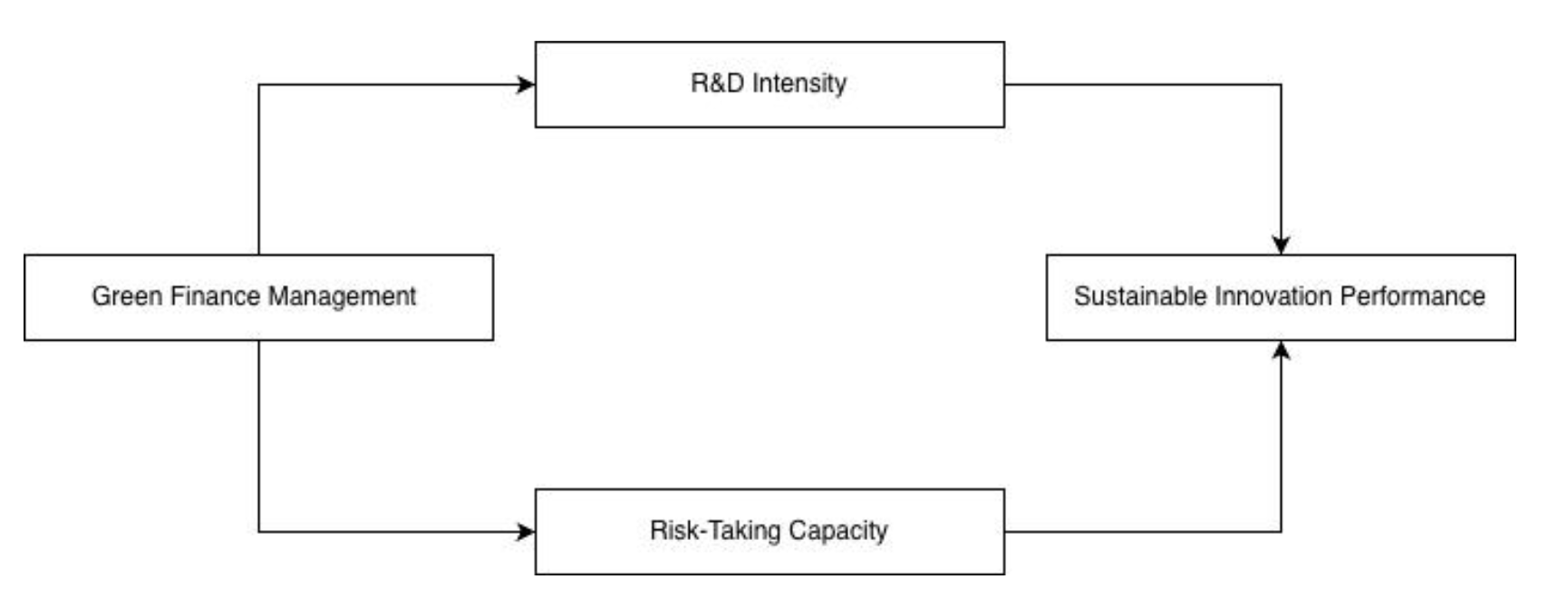
This study conceptualizes green finance management as a strategic managerial capability and investigates how it influences corporate sustainable innovation performance. Using a multi-industry panel of Malaysian listed firms from 2019–2024, fixed-effects regression and parallel mediation analysis are employed to examine the effects of green finance management on green innovation output and long-term financial performance, with R&D intensity and risk-taking capacity as mediators. Green finance management significantly enhances both green patents and long-term ROA. Its impact on green innovation operates primarily through two internal mechanisms: increased R&D intensity and expanded risk-taking capacity. When both mediators are included, the direct effect becomes insignificant, indicating a robust parallel mediation structure. Green finance functions through organizational reconfiguration rather than mechanical capital transfer, underscoring its managerial role in shaping sustainable innovation trajectories.
References
1.Aghion, P., Dechezleprêtre, A., Hémous, D., Martin, R., & Van Reenen, J. (2016). Carbon taxes, path dependency, and directed technical change: Evidence from the auto industry. Journal of Political Economy, 124(1), 1–51. https://doi.org/10.1086/684581
2.Barney, J. (1991). Firm resources and sustained competitive advantage. Journal of Management, 17(1), 99–120. https://doi.org/10.1177/014920639101700108
3.Bolton, P., & Kacperczyk, M. (2021). Do investors care about carbon risk? Journal of Financial Economics, 142(2), 517–549.https://doi.org/10.1016/j.jfineco.2021.05.008
4.Boubakri, N., Cosset, J. C., & Saffar, W. (2013). The role of state and foreign owners in corporate risk-taking: Evidence from privatization. Journal of Financial Economics, 108(3), 641–658. https://doi.org/10.1016/j.jfineco.2012.12.007
5.Broadstock, D. C., Chan, K., Cheng, L. T. W., & Wang, X. (2021). The role of ESG performance during times of financial crisis: Evidence from COVID-19 in China. Finance Research Letters, 38, 101716. https://doi.org/10.1016/j.frl.2020.101716
6.Hall, B. H., & Lerner, J. (2010). The financing of R&D and innovation. Handbook of the Economics of Innovation, 1, 609–639.https://doi.org/10.1016/S0169-7218(10)01014-2
7.Kahn, M. E., Mohaddes, K., Ng, R. N. C., Pesaran, M. H., Raissi, M., & Yang, J. C. (2021). Long-term macroeconomic effects of climate change: A cross-country analysis. Energy Economics, 104, 105624.
https://doi.org/10.1016/j.eneco.2021.105624
8.Pankratz, N., Bauer, R., & Derwall, J. (2023). Climate change, firm performance, and investor surprises. Management Science, 69(12), 7352–7398. https://doi.org/10.1287/mnsc.2022.4604
9.Teece, D. J. (2018). Business models and dynamic capabilities. Long Range Planning, 51(1), 40–49.https://doi.org/10.1016/j.lrp.2017.06.007
10.Tripopsakul, S. (2025). ESG practices, green innovation, and financial performance: Panel evidence from ASEAN firms. Journal of Risk and Financial Management, 18(8), 467. https://doi.org/10.3390/jrfm18080467
Details
License
Copyright (c) 2026 Chenlu Yu, Xiaoming Wang, Wencan Zhang, Wei Yet Tan

This work is licensed under a Creative Commons Attribution 4.0 International License.